A Legend Denied Its Moment
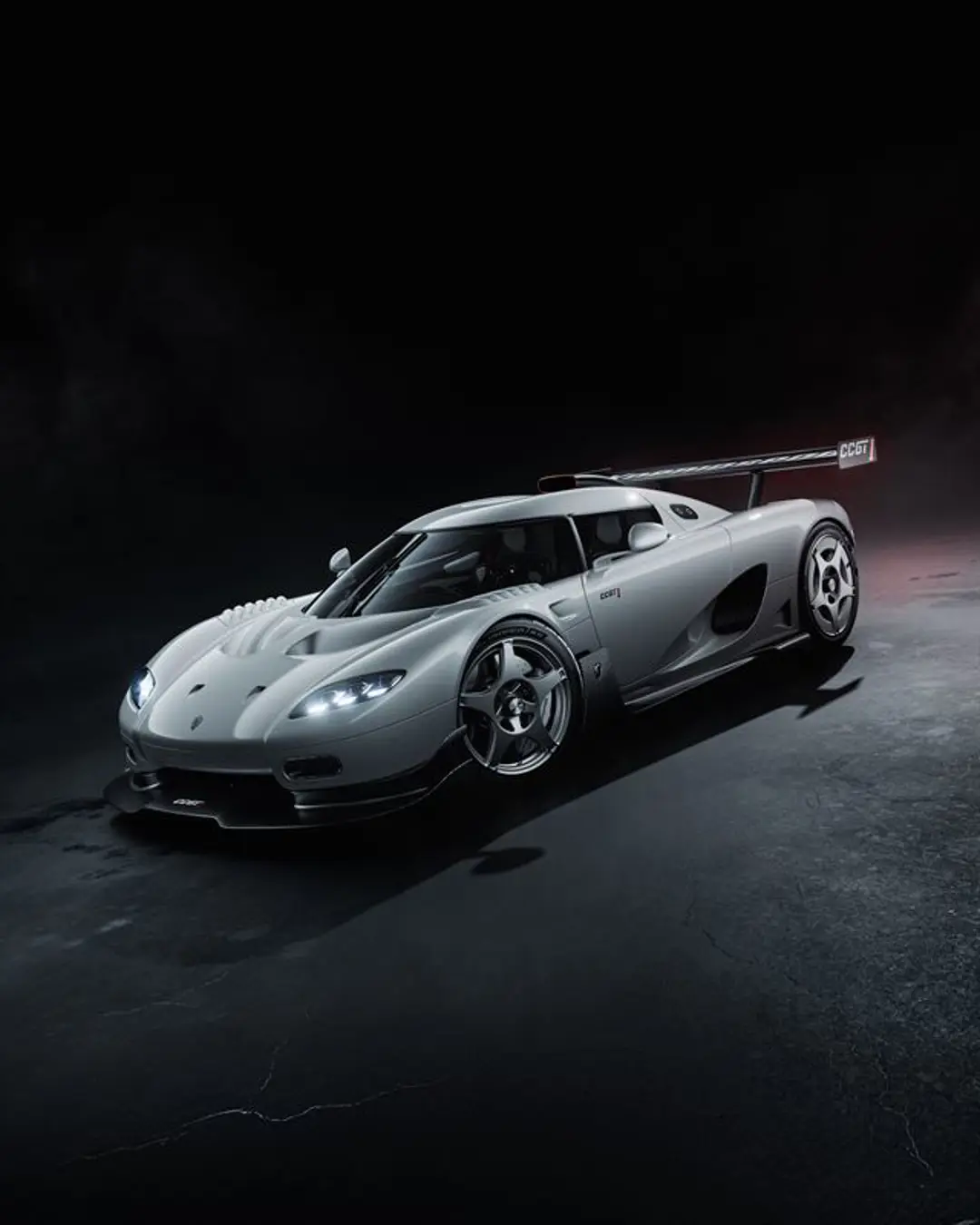
In 2007, Koenigsegg completed one of the most ambitious projects in the company's history: the CCGT, a purpose-built GT1 endurance racer designed to compete at Le Mans. Christian von Koenigsegg had studied the GT1 regulations meticulously from the very beginning of his sportscar endeavours, scaling the width and frontal area of the first CC prototype to fit within the class rules without modification, a discipline that would define Koenigsegg's initial models for years to come. The CCGT was fitted with a naturally aspirated 5.0-litre V8 producing 600 hp in race trim, generating over 600 kg of downforce, and came in at approximately 1,000 kg, well under the class limit of 1,100 kg. Legendary test driver Loris Bicocchi set the car up and from its first laps it showed genuine competitive pace. Then, two months into shakedown testing, the FIA rewrote the GT1 regulations to require higher production volumes. Manufacturers withdrew, the series collapsed, and the CCGT never turned a competitive lap. Only one was ever built. Today, under the care of a new US-based custodian and fully refurbished by Koenigsegg's Legend Division, the original CCGT finally awaits its competitive debut in GT1 historic racing, against the competition it would have faced two decades ago. The CCGT1, revealed at Monterey on 13 August 2026, exists to honour that moment.

1,600 hp, 800 kg of Downforce and a New Way to Shift
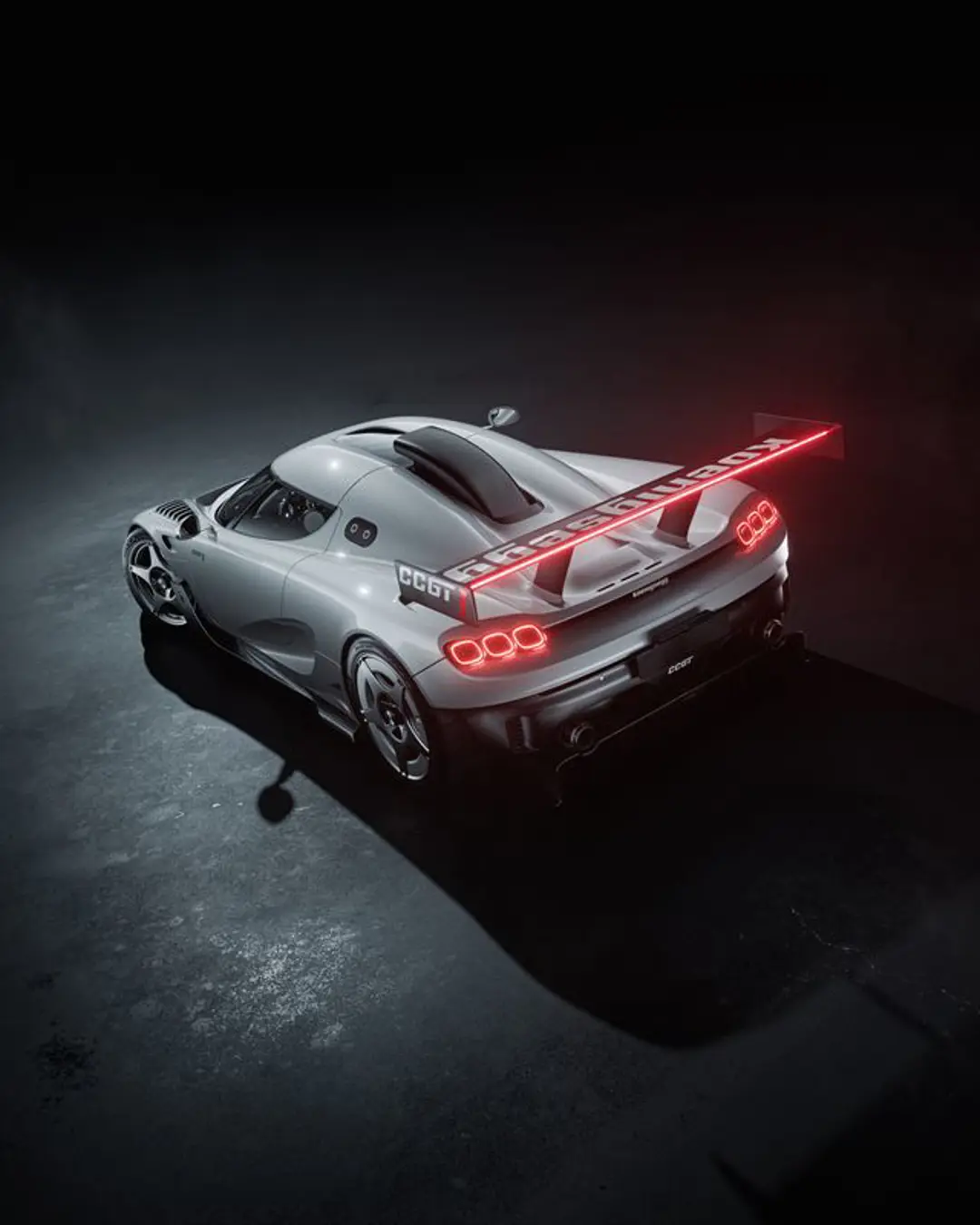
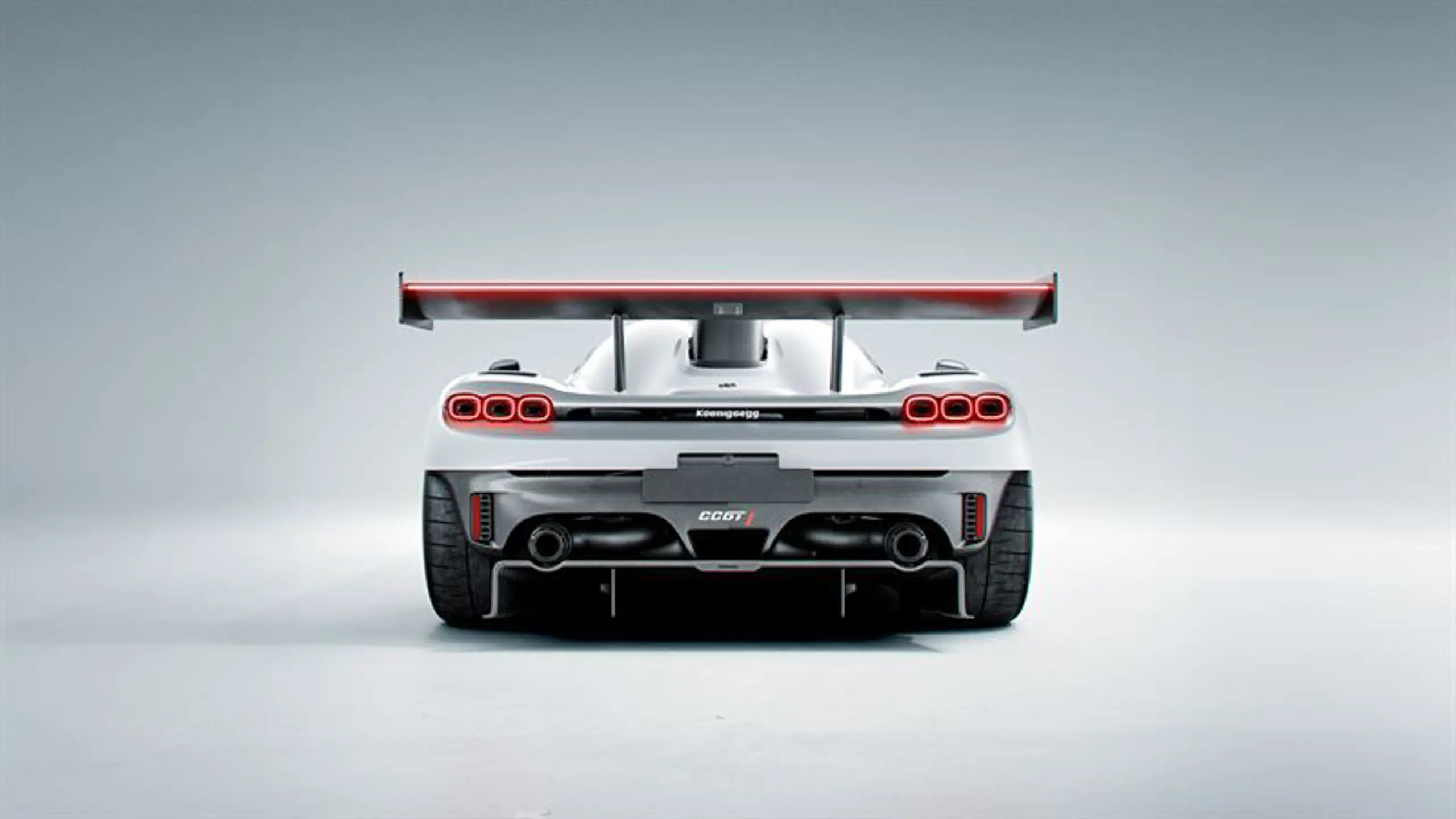
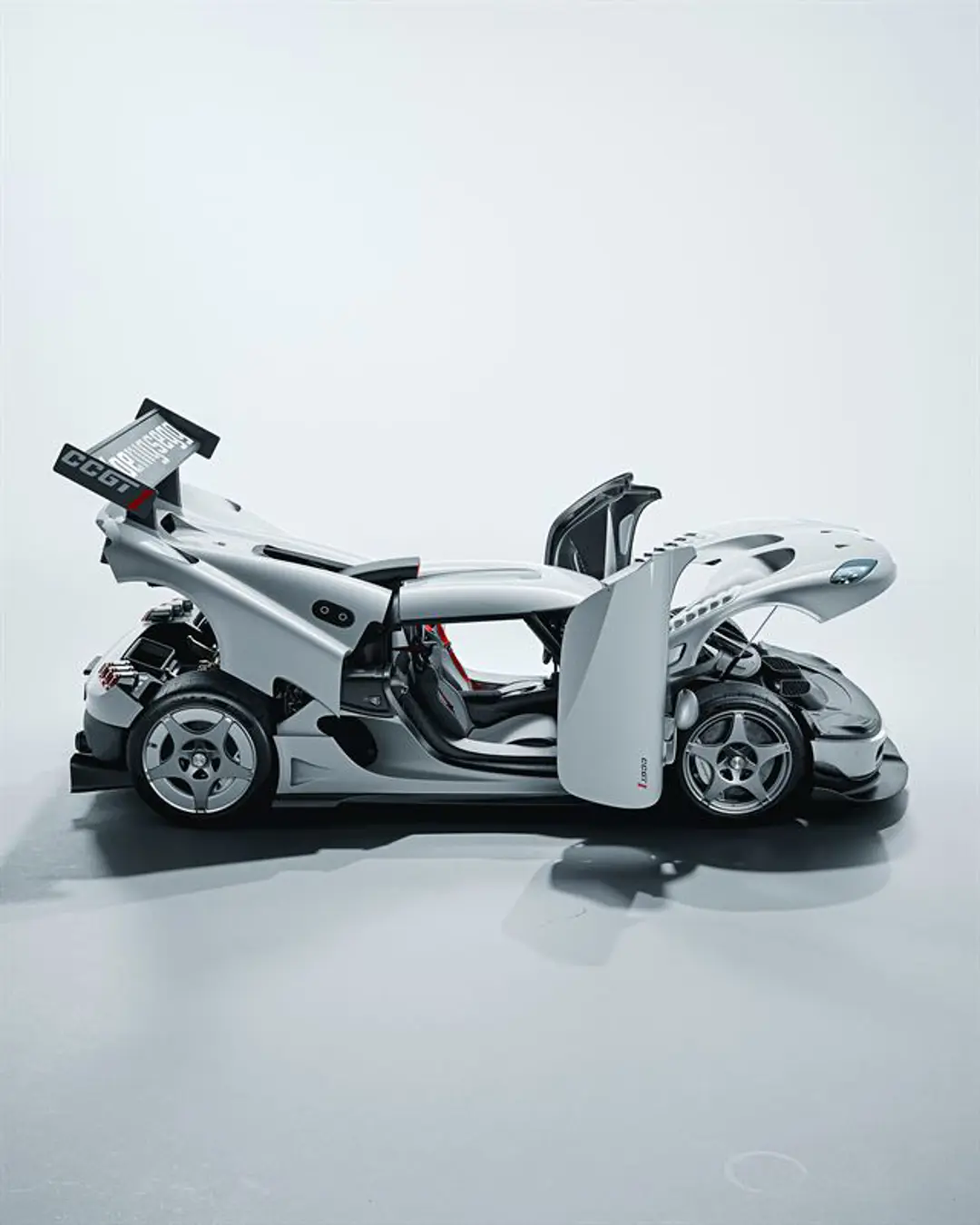
Built on the award-winning CC850, itself a tribute to the CC8S that started everything for Koenigsegg, the CCGT1 carries the CCGT's name and spirit into a fully homologated, road-legal Megacar. Nearly every body panel has been redesigned from its CC850 origins; only the doors and removable roof remain. The aerodynamic programme, led by CFD engineer Andreas Tjernberg Persson, was built around two goals: greater usable downforce and sufficient cooling capacity to sustain full track sessions at racing speeds. The result is 800 kg of downforce at 250 km/h, placing the CCGT1 between the Jesko Attack and Sadair's Spear in Koenigsegg's own downforce hierarchy, delivered primarily through a sculpted underfloor with strakes generating low-pressure vortices and a bespoke rear diffuser, supported by a large active rear wing with 30 degrees of automatic adjustment that transitions between low-drag, air-brake and high-downforce modes without driver input. The powertrain is Koenigsegg's twin-turbocharged V8, producing 1,280 hp on standard pump fuel and 1,600 hp on E85 biofuel, with the ability to run on any blend of the two through Koenigsegg's in-house engine management system. A new roof scoop feeds an enlarged oil cooler and a dedicated damper cooling system, ensuring performance consistency across sustained track sessions rather than only in short bursts. Standard transmission is the new Koenigsegg Sequential Shift, a bespoke sequential shifter featuring a clutch pedal for take-off and ignition-cut clutchless shifts, channelling the character of the original CCGT's magnesium sequential gearbox through the nine-speed Light Speed Transmission. For those who prefer a more analogue approach, the CC850's award-winning Engage Shift System six-speed gated manual remains available as an option, because on a car that exists to celebrate driver engagement, the choice of how to shift belongs entirely to the driver.
Ghost Fibre and the Return of White Carbon
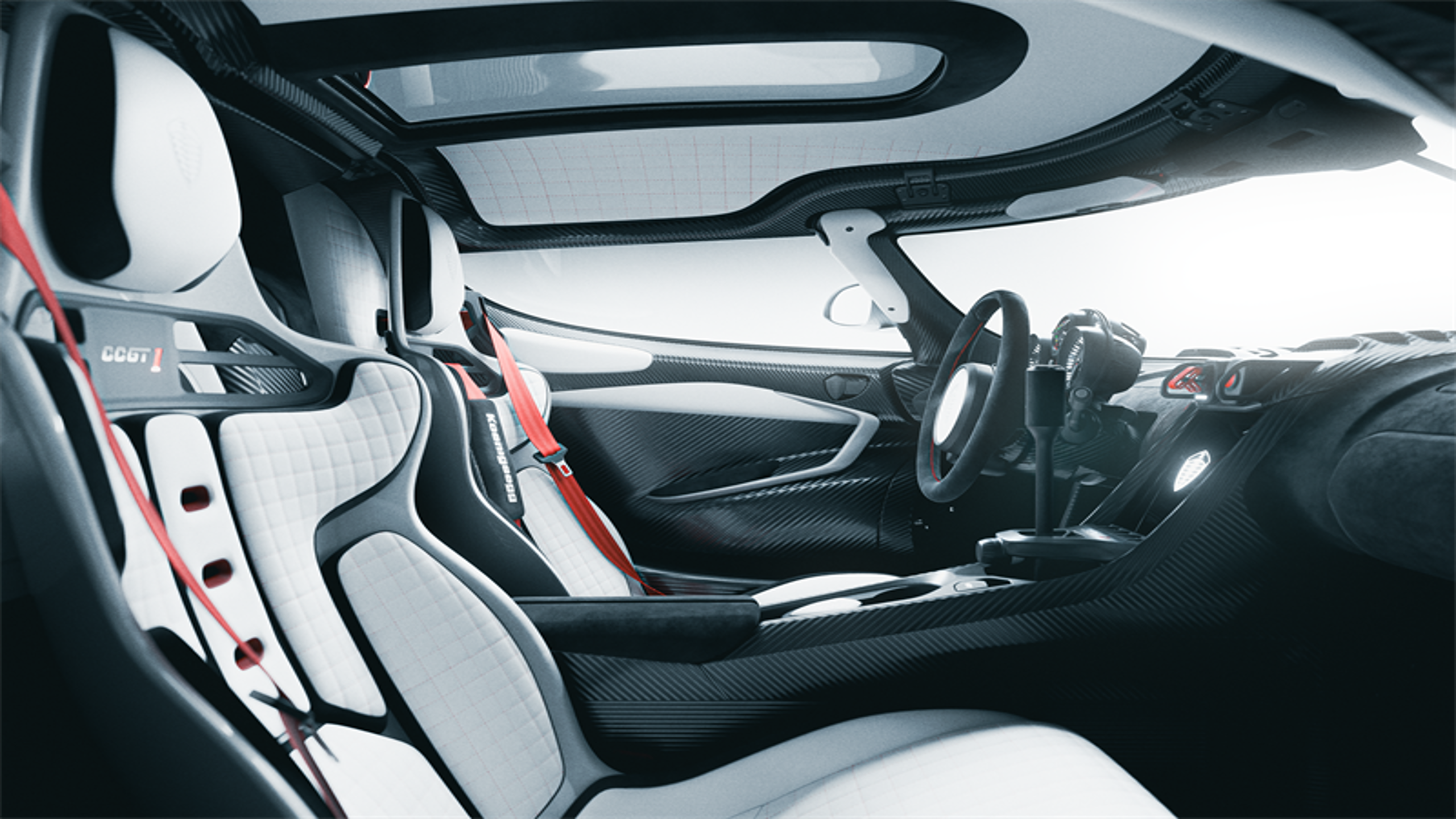
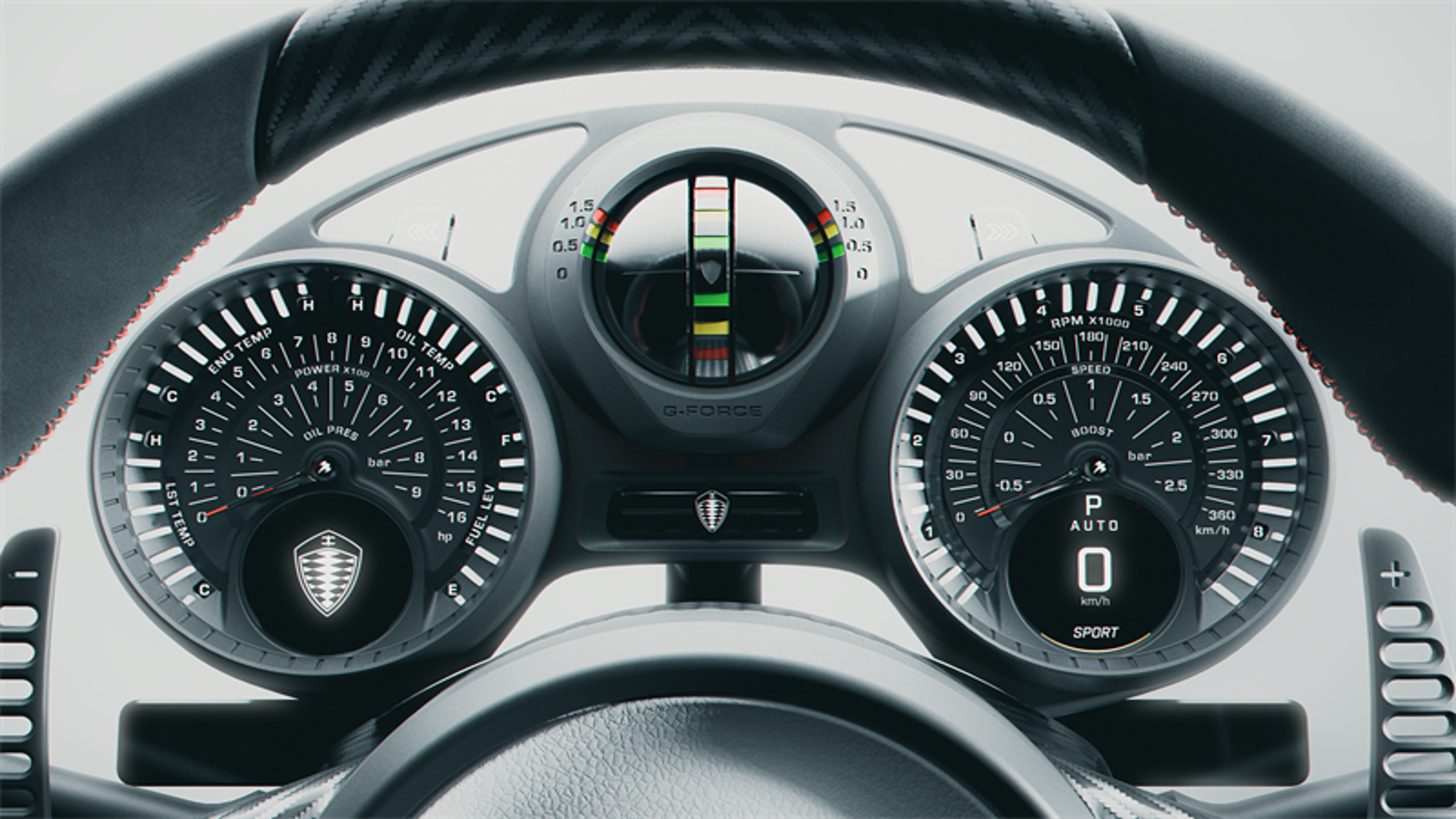
The CCGT1 introduces Ghost Fibre, Koenigsegg's ground-up reimagining of the white carbon fibre first showcased on the Trevita project in 2009. That original technology took years to develop and proved so challenging to execute consistently that production was halted, despite the enthusiasm of clients who experienced it. Ghost Fibre addresses what the Trevita could not: beyond its distinctive crystal-white shimmer, described as something akin to a white aramid and carbon matrix finished with the precision of a perfect Koenigsegg weave, it provides ballistic protective characteristics that add toughness to the panels, a sound-deadening effect that contributes to refinement on the road, and a construction that allows the panels to be lighter than those produced using a traditional carbon-only layup. It is a material that manages to be simultaneously more beautiful and more capable than what it replaces. The cockpit makes the CCGT1's intentions clear before the engine starts: a covered ignition switch, a fuel pump prime toggle and a red starter button frame the driving experience in the language of motorsport from the first moment. The third-generation Chronocluster keeps all essential information in the driver's sightline, with Koenigsegg's analogue G-meter, driven entirely by G-force with no electrical connection, positioned at the centre of the cluster. Standard seats are ultra-light carbon fibre with a six-point harness for the driver, while Koenigsegg's touchscreen infotainment system ensures the cabin remains equally suited to a Sunday drive as to a full circuit day.
The First Koenigsegg Factory Track Package
For clients who intend to explore the CCGT1's full capabilities, Koenigsegg is offering its first-ever factory-designed track package, a comprehensive transformation that can be installed and removed by any Koenigsegg Certified Dealer. The package includes a full carbon roll cage, HANS-compatible racing seats, a fire-suppression system, race exhaust, air jacks, track-focused suspension and brake setup, a second set of rims fitted with track-optimised tyres, enhanced aerodynamics, and an invitation to exclusive CCGT1 track days with full factory support. Once fitted, the package transforms a world-class road car into the fastest-lapping Koenigsegg ever built, a statement that carries particular weight when the car making it sits between the Jesko Attack and Sadair's Spear in its manufacturer's own performance hierarchy. The CCGT was never allowed to prove what it could do in competition. The CCGT1, two decades later, ensures that the question is finally, definitively answered, on road and track alike, in a car that carries the weight of that unfinished story with both precision and pride.